
Silent Landscapes
Giuliano Giuliani at The Warehouse, Dubai, from 13 February 2027
by Giacomo Belloni 4 min
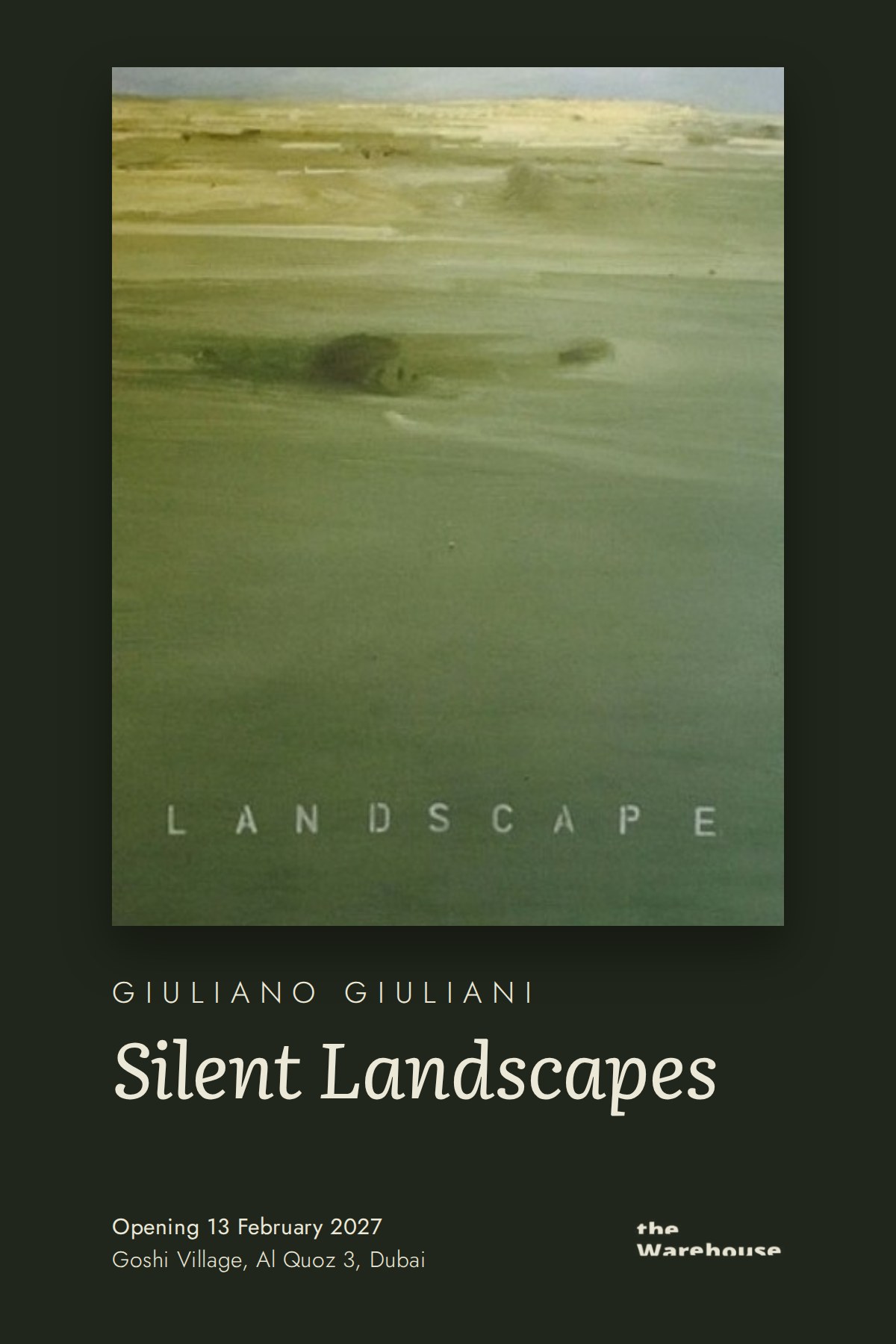
On 13 February 2027 Giuliano Giuliani returns to Dubai with a solo exhibition titled Silent Landscapes, at The Warehouse in Goshi Village, in the heart of Al Quoz 3. It follows the success of his solo show at the Dubai Design District a few years ago.
For anyone who has followed his work for some time, the title will sound familiar. Years ago I wrote about his “silent landscapes” in the pages of a well-known Italian art magazine, and meeting them again today, a few thousand kilometres from Italy, feels strange in a way I did not expect.
The silence of those canvases has stayed the same, but the city that hosts them is a very different place. Dubai is extremely dynamic and always on the move. It is a city in perpetual transformation, a place with a pulse of its own, where little room is left for waiting or for silence. That is precisely why Giuliani’s painting will find a particularly attentive audience here, people who long for the quiet of his work. Walking into a room where the paintings never raise their voice and speak softly instead means having to slow down, and at last giving the eye time to settle into their poetic calm.
Giuliani’s silent landscapes do not describe a specific place. There are no recognisable hills or picture-postcard coastlines; often even the horizon is missing, lost in a haze where sky and land run together. What remains is paint: glazes laid over other glazes, countless layers settling one upon another until they create a depth that belongs to time before it belongs to perspective. The artist leaves the traces of his work visible, scratches and second thoughts included, so that the finished painting keeps something of the process that produced it.
Even back then I was struck by the way he builds the image through superimposition. There is no attempt to simulate three-dimensional depth. The planes stay flat, and it is from their succession that a different kind of space emerges, unlike that of traditional perspective. Each layer carries the previous one with it, even when it almost hides it. Look for long enough and you notice something coming back to the surface. This is painting that keeps both its hesitations and its certainties, as though every canvas held on to the memory of the time spent painting it.
There is a sentence of his that I still consider the key to this cycle: “There is no space without time, no time without space. Here, with this painted space, stretched across distinct planes, I have recovered the measure of time.” It stayed with me, tied to the slow construction of his paintings, and years later it still explains well what happens on the canvas. The time involved is not only the time Giuliani spent painting; it is also the time asked of whoever stands in front of the work.
This is why the quick glance that screens have accustomed us to is of little use here. Tonal gradations and transparencies emerge slowly. Some differences only become visible after giving the work the attention it deserves. It is almost the opposite of the flood of images we consume every day, seen and immediately replaced by others. These paintings do not work like that. They have to be given time.
And perhaps the finished painting is not even the real centre of Giuliani’s work. It is what remains of a process made of additions, erasures and returns. The surface holds this history without spelling it out. There is no need to reconstruct the order of the brushstrokes. It is enough to know that beneath what we see, something is still alive.
Then there are the titles, often painted directly onto the canvas. Giuliani wants them light yet legible, free of ambiguity, and never allowed to turn into separate captions. They stay inside the painting; they are the painting. Years ago I described them as a continuation of the visual message on another level of perception. I still see them that way: the words add something, but they do not explain the picture; they belong to it.
And there is solitude, which in his work often takes the form of a single tree in the fog. What interests Giuliani above all is the loneliness of someone who feels alone among other people. “I paint my solitude,” he has written, “I paint the despair of all those who feel alone in the crowd. I paint absence among invisible presences. I paint presence by means of absence.”
It is an important distinction. Giuliani is not simply talking about creative isolation, the kind every painter needs. He is talking about a solitude that can grow deeper precisely when others are around. The tree lost in the haze then becomes more than a recurring feature of the landscape, and it is not hard to see why it keeps returning in his work.
Seeing these works in Dubai inevitably adds something to the way we read them. Not because Giuliani painted them with this city in mind, but because few cities make the paradox of the crowd so plain. Here people meet all the time, languages and backgrounds cross, and daily life is spent among people who have come from every corner of the world. And yet, surrounded by so many, one can remain deeply alone.
Perhaps this is also why his silent landscapes arrive in Dubai without looking out of place. They have no need to adapt to the city. All they ask is that, for a few minutes, the people looking at them adapt to their time.
The exhibition opens on 13 February 2027 at The Warehouse, Goshi Village, Al Quoz 3, Dubai. Best to go without hurrying.